Sunday, 14 September 2014

Wampler Plexi-Drive British Overdrive Demo

Wampler pedals are designed by Brian Wampler and handbuilt in the USA.  The Company's website is not shy in telling the world how good these pedals are, describing them as "the most inspiring and musical guitar effect pedals available today" and "the bench mark for boutique level effects pedals worldwide".  No small claims!

I have two Wampler pedals in my rack - the Ego Compressor and the pedal that's the subject of this post, the Plexi-Drive British Overdrive.  I bought both pedals from Andertons in Guildford, here in the UK.  Unfortunately, the Plex-Drive had a broken switch.  I should have taken it back, but as I place most of pedals in a rack rather than on a board, the fact that the switch was faulty didn't affect the way I wanted to use the pedal.

As the name implies, this pedal is designed to make your rig sound like a Marshall amp.  The pedal features three simple controls - Gain, Tone and Volume, plus a Bass switch that adds some serious thump to the bottom end.  What I like best about this pedal is the huge range of useable tones, from light gain to seriously overdriven.

In the video, I'm experimenting with different levels of gain and different pick up selections on my Suhr Modern Custom, to demonstrate the range of sounds available.  I also added a little delay from a Way Huge Aqua Puss and Echo Puss, and reverb from a Hermida Reverb 2.


Saturday, 15 February 2014

Eric Johnson's Pedalboard and Amp Rig

From the moment I heard the opening notes of Cliffs of Dover, I loved Eric Johnson's playing.  He's one of my favourite guitarists!  I was fortunate to get a ticket to an intimate Masterclass with the great man, held at the Radisson Hotel in Guildford, on 5 July 2012, organised by Andertons Music Co. I arrived early and was able to secure a seat on the front row, right in the middle, which I considered to be the best seat in the house!

Mick Taylor, then Editor of Guitarist Magazine, was the compere.  After a brief introduction from Mick, in which he told us that Eric was in the wings filing his pick on wet and dry paper, the band came on and played stupendous versions of Manhattan, Fat Daddy, Gem and Mr Pc.  Mick then facilitated questions from the floor, with Eric standing at the mic providing answers and demonstrating aspects of his awesome technique.  The band finished with an extended version of Cliffs of Dover.

We were asked not to take photos during the show, but I found the one included here on the Internet, taken by someone who was sitting a few rows back from me. All other photos are mine. After the show, Eric came out to sign merchandise and talk to his fans.  I bought a Tour t-shirt and a poster, which he signed.  I shook his hand and told him I loved the show, and he graciously thanked me.

There are lots of great pictures of Eric's pedalboard on the Internet, including on his own web site. My own photo isn't great by comparison, but it does show what I believe are the following pedals: Ibanez Tubescreamer, Fuzz Face (which looks like the gold signature model), Toadworks Barracuda Flanger, Cry Baby Wah, TC Electronic Chorus/Flanger, Electro Harmonix Deluxe Memory Man, Boss Digital Delay, and various A/B switches.  Eric's board is pretty scruffy, with long coils and tangles of cable, but that's the way he likes it!

Eric was using his old Marshall amp heads and 4x12 cabs, plus what he described as prototypes of new Fender amps being built for him.  I was interested to see that Eric angles his amps away from him.  There was a lot of hum and buzz, which surprised me. Eric said it was because he was using vintage amps, but it sounded like ground hum to me.  I've no idea whether his A/B switches contain isolation transformers to prevent ground loops, and this may be the problem.  Anyway, extraneous noise aside, this was an absolutely cracking event, with Eric in magnificent form.  

Now, if only I could play like that ...


Thursday, 6 February 2014

Xotic Effects RC Booster and AC Booster


Xotic effects pedals are rather special!  I first discovered them when I was surfing the web and came upon the Prosound Communications web site.  I kept going back to this web site time and again to watch the Reality Web videos of pro guitarists putting the Xotic effects through their paces.  This was my first introduction to Scott Henderson and Allen Hinds, who are now two of my favourite players.  At that time, Xotic effects were not easy to find in the UK, but I discovered that Jam Guitars in Clifton, Bristol, were stockists. Sadly the specialist shop in Alma Vale Road is no longer open, although the compoany still trades online.  It was from Jam Guitars that I bought the RC Booster and AC Booster.


The RC Booster is a clean boost pedal offering 20db+ of clean boost, with controls for Volume, Gain, Treble and Middle.  For me, the two-band active EQ allows for more tone shaping than a simple Tone knob.  The AC Booster has the same controls and can be used as a booster or overdrive pedal.

I like to set the RC Booster to give my sound a bit of a push for clean lead passages, and use the AC Booster on a mild overdrive setting for more of a vintage flavour.  These pedals are solidly built, using high quality components.  I also have an EP Booster, which I might write about on another occasion.


Xotic effects are now available from more shops in the UK, and the line has expanded to include several other pedals, including the new small enclosure models.

There are lots of Artist testimonials on the website, and I would add my own voice to these: Xotic effects are great pedals and a worthy edition to any pedalboard or pedal rack!

Wednesday, 5 February 2014

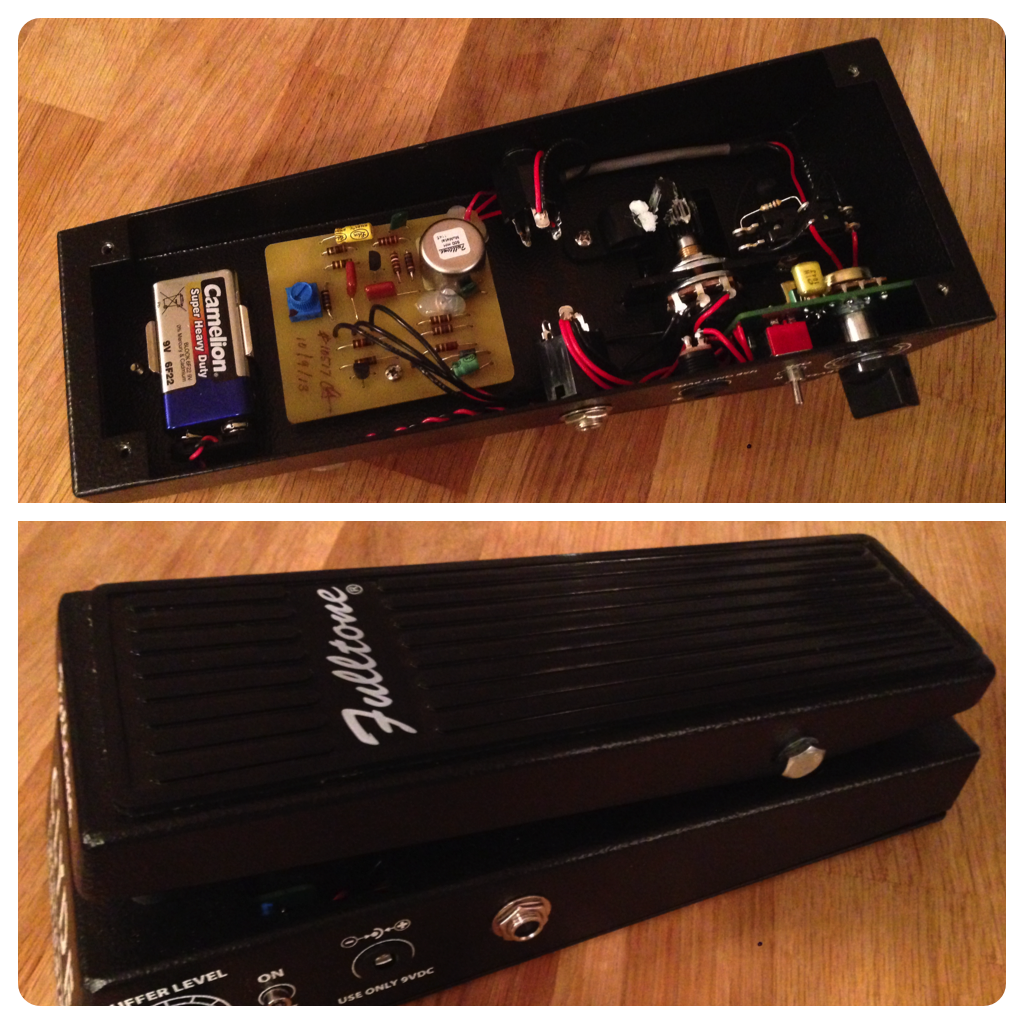
My new favourite Wah: the Fulltone Clyde Standard

My first wah pedal was a Jen Crybaby, purchased in the 1980s from Cooke's Band Instruments in Norwich.  I used it along with an Ibanez Sonic Distortion (which I had chosen in preference to a Tubescreamer!) and an Electro-Harmonix Small Stone Phase Shifter. Sadly, I no longer own any of those pedals.  I sold the Crybaby to fund the purchase of a Vox V847 Wah, which I later modified with a True-Bypass kit purchased from an eBay seller. This involved a bit of soldering to replace some of the components, resulting in less treble loss.  The V847 will soon find a new home, via eBay, as I have a new toy: the Fulltone Clyde Standard wah.

I'm a big fan of Mike Fuller's Fulltone effects.  I also have a '70 Fuzz, a Fat Boost and a Mini Deja Vibe.


Clyde McCoy was an American jazz trumpeter.  He developed the signature "wah wah" sound in the late 1920s by fluttering a mute in the bell of his trumpet.  In 1967, Vox introduced the Clyde McCoy Wah-Wah Pedal to replicate this sound for electric guitar.  This pedal was used by both Jimi Hendrix and Eric Clapton.  Mike Fuller says he took the best from his collection of more than 25 Vox Wah pedals in the development of his Clyde Standard Wah.

I'm really enjoying this pedal.  It has a wide sweep, and is particularly good with fuzz and overdrive, owing to the switchable Booster/Buffer, which Mike describes as being a "fuzz-Friendly" circuit.  I also like the fact that it runs on either a 9v battery or can be powered with an AC adaptor.  This means it can be hooked up, along with my other pedals, to my Generator and Distributor power system from TheGigRig.  Now, if only I could play like Hendrix or Clapton ...

Friday, 31 January 2014

MXR Modulation - Analog Chorus, Micro Flanger, Custom Shop Script Phase 90

I love modulation!  Whether it's an ethereal touch of chorus, phasing or flanging to add interest and variety to a song, or a great cascading, swirling soundscape, modulation can be hugely fun to use.  These three pedals from MXR - the Analog Chorus, Micro Flanger and Custom Shop Script Phase 90 - are just what you need to create other-worldly sounds.

The Analog Chorus uses bucket brigade circuitry to create lush, liquid textures. In addition to the usual Level, Rate and Depth controls found on many chorus pedals, there are two additional knobs labelled Low and High, which are used to control the amount of low and high frequently cut respectively.  The pedal can be run in mono or stereo. What I like most about this pedal is its ability to replicate those wonderful 1980s "in your face" chorus sounds, when it seemed like every rock guitarist's sound was awash with modulation.  This pedal can do subtle, but it can also do big and bold.


The Micro Flanger was originally launched in the 1980s.  According to Dunlop, who now owns and distributes the MXR brand, this pedal is a faithful recreation of the original, with the same simple controls: a Rate knob to control the speed of the flanging effect and a Regen (short for regeneration) knob to control the intensity. Technology is 100% analog bucket brigade for a warm, organic tone. This new version has a true-bypass switch, and offers everything from jet plane swoops to cool outer-space effects.  It also sounds great with my Fulltone '70 Fuzz pedal.

The Custom Shop Script Phase 90 is a special pedal!  The original version was available from MXR's inception through to the late '70s and can be heard on everything from hard rock to jazz-fusion to funk hits.  Dunlop says this pedal "brings back the headroom and clarity of the original, along with its ultra warm and smooth phasing and reduced midrange swell".  You also get the original smooth orange paint job and script logo, and my version has the added benefit of a LED.  The pedal delivers smooth and lush 4-stage phasing.  I love using it with my Free the Tone SOV-2 overdrive and a touch of delay courtesy of a Way Huge Echo Puss.


Wednesday, 28 August 2013

Set the SOV-2 Free

The Free The Tone SOV-2 Overdrive is something quite special.  Evolving from the Providence SOV-2 Stampede, it has an ultra-boutique vibe with hand-written labels, and bears the signature of its designer, Yuki Hayashi.  With simple level, tone and drive controls, it offers anything from a cleanish boost to a thick overdrive.

In this video, I played a few simple lines and chords, using my Suhr Modern Custom through a Rivera Clubster Royale Top and a little Orange PPC 112 with a single Celestion Vintage 30 speaker.  I kicked in a Way Huge Echo Puss Analog Delay at 4:53, to add a little more ambience.


Friday, 16 August 2013

Amp Cat

It must be an accepted fact that cats like guitars, and they are particularly enticed by the lure of the soft interior of a plush guitar case.  It's my observation that cats also like amplifiers, and if its an amp head on top of a 4x12 cabinet nothing could be better.  Cats, of course, like a high vantage point.  It gives them a sense of security, while affording them a better view of their territory, but cats also know how to be cool.  My own cat is no exception, and is shown here enjoying an Orange AD30 HTC, Rivera Venus 5 and Cornford MK50ii, as well as various cabinets.  Cool cat!  


Friday, 9 August 2013

Way Huge Echo Puss with Suhr Modern Custom and Cornford MK50ii

I've used quite a few different delay pedals over the years, and there really is something magical about the Way Huge Echo Puss, designed by delay expert Jeorge Tripps.  It provides up to 600ms of delay from a pair of what Dunlop Manufacturing describes as "gravelly-voiced" bucket-brigade chips. The repeats are certainly dirty - no pristine digital delay-like repeats here.

This video is not exactly a demo of the Echo Puss, but the pedal is on most of the time.  Sometimes the repeats are short and low in the mix; at other times I've used longer repeats with the blend control turned up higher. (You can hear the pedal really kick in at 3:50.)

The guitar is my Suhr Modern Custom with korina body and cherryburst flame-maple top.  I'm playing through a Cornford MK50ii amp head and Marshall Vintage Modern 425A cab with G12C 25 watt Celestion Greenback speakers.  I played a few riffs and jammed through some chords and lead lines.  I just stuck my iPhone infront and played - so no high-tech studio recording gear here!


Sunday, 14 April 2013

Wall of Fuzz

(I can't Get No) Satisfaction, released in 1965, was the first US number one hit for The Rolling Stones and their fourth UK number one.  Keith Richards' driving three note riff was apparently intended to be replaced by horns.  Instead, it unleashed the Fuzz pedal sound on an unsuspecting world.  The Gibson/Maestro FZ-1 Fuzz Tone pedal was created in 1962, but it was The Stones' hit that really put it on the map and boosted sales.

The heavily distorted sound, known as Fuzz, was originally created by ripping or poking holes in a guitar amp speaker, before it became available in pedal-format.

Other early examples of Fuzz pedals include the Sola Sound Tone Bender (MK1 was released in 1965 and MK11 in 1966), built using germanium transistors and used by many famous British guitarists, the Arbiter Electronics Ltd Fuzz Face (1966), and the Electro-Harmonix Big Muff Pi.  Although Jimi Hendrix performed and recorded with a Fuzz Face, the story goes that he bought a Muff within the first week of them going on sale.

It was, in fact, the Big Muff, which gave me my first taste of Fuzz, and it was a jaw-dropping experience.  I was in awe of the wall of sound!  For me, though, there were three problems with this pedal: firstly, I found it a little too metallic for my liking; secondly, it was a roaring beast which burst into a wail of noise as soon as I hit the switch and could only be tamed with a noise supressor pedal (the ISP Decimator being my weapon of choice); and thirdly, it just didn't cut through the mix in a live band situation.  This third point is a well-known problem with fuzz pedals.  Maybe I just had a bad example, but much as I loved this pedal it ended up on eBay.

I was then fortunate to acquire a second hand Mojo Hand Huckleberry.  This was an early 3-knob version (Mojo Hand added a Juice knob to the later version).  Whilst a few retailers are still offering this pedal for sale, it has been discontinued and superseded by the new range of Fuzz pedals available from the company (Iron Bell, Crosstown, One Ton Bee, Zephyr and Colossus - all great names for Fuzz pedals).  The Huckleberry is described as a Fuzz Face cross-bred with a Muff, with both silicon and germanium transistors, and the wall of Fuzz it creates is a beautiful sound!


My Fuzz Pedal of choice these days, however, is the Fulltone 70-BC, which features two intentionally mismatched silicon transistors.  The addition of the Mid knob really helps it cut through the mix.  It also sounds amazing used along with a Flanger.

Hendrix, of course, knew exactly how to use a Fuzz pedal.  Using different pickups and manipulating his volume control, he could produce a full-on howl, fat-sounding tone and detailed clean textures as well.  If you've not tried a Fuzz, you need to get experienced!

Thursday, 4 April 2013

Skip to the Chorus


So, you want to add a thick, rich, lush, multi-dimensional shimmer to your guitar tone?  You need a chorus pedal!

The chorus effect first became available to guitarists with the 1976 release of Roland’s Boss CE-1 Chorus Ensemble with chorus and vibrato effects.  The effect was taken from the Roland Jazz Chorus amplifier, first released in 1975.  Chorus ensemble effects had previously appeared on keyboards.  Fortunately, today’s chorus pedals are not as big or heavy as the CE-1, may not disappoint you with a slight drop in volume when they’re on, and may feature true-bypass so as not to mess with your tone when they’re off.  In spite of these modern improvements, there are many who regard the CE-1 as unsurpassed for its thick, rich chorus and dreamy vibrato, and they continue to change hands for handsome sums.

What does a chorus pedal do, I hear you cry?  Put simply, the input signal is repeated in close intervals (milliseconds) to make the output sound like multiple voices.  The depth control increases the intensity of the effect and the rate control alters the delay time of the repeats.

I first encountered chorus when a friend loaned me a light blue Boss compact pedal.  It may have been a CE-2 or perhaps a CE-3.  I was blown away by it and I’ve been hooked on chorus ever since.  When I eventually purchased my own chorus pedal, it was a Boss CE-5 Chorus Ensemble.  If I’m honest, I would say it was okay, but it lacked some warmth.  The CE-5, I believe, uses a digital chip, unlike some of its analog predecessors.  Maybe that was the problem!

The CE-5 ended up on eBay (and I hope the new owner was pleased with it) and I spent the money on a second hand Jacques Meistersinger, also an eBay purchase.  The seller told me he had an Electro Harmonix Poly Chorus and he couldn’t justify putting both pedals on his pedalboard.  My initial impression, on beholding the Meistersinger, was that it was housed in a particularly unaesthetically pleasing case.  Let’s be honest - it’s an ugly pedal, but what a sound!  Jacques says he took his inspiration from the TC Electronic Chorus/Flanger, the Boss CE and Dimension products, and the Electro-Harmonix Small Clone.  Interestingly, Jacques has recently changed the housing of his pedals, but looks aside, I love this pedal!  What makes it so special?  Could it be that it uses true analog delay chips?

Modern technology continues to push the boundaries of what effects pedals can do.  Eventide’s line of stompboxes has presented guitarists with a huge pallet of choice.  The Mod Factor offers four different chorus effects: liquid, shimmer, organic and classic, with deep editing of the parameters and MIDI control.  All of this is perfect if you need lots of different chorus options, but to my ears the Mod Factor sucks some of the tone out of my sound and adds a bit of noise.  The Mod Factor is a truly wonderful creation, but if I was going to be stuck on a desert island with just one chorus pedal, I’d take the Meistersinger, thanks very much!

Wednesday, 3 April 2013

Wha's Up, Doc?


Could there be a better place to start a blog about effects pedals than with the ubiquitous wah-wah?  No pedalboard is complete without one. Every 1970s crime-buster TV show theme tune had to have one (just listen to Charlie’s Angels or The Professionals and you’ll know what I mean).  In December 2012, Guitarist magazine placed a wah-wah - the Dunlop Crybaby Classic - in the number one spot in its list of 101 greatest stomp boxes.

If you want to get technical about how it works, there’s plenty of information on the Web, but let’s keep things simple here: the wah-wah (or “wah”) is a filter that alters the tone of the signal.  As you rock the pedal with your foot, it sweeps the peak response of the filter up and down in frequency to create the sound.

The birth of the wah was serendipitous!  It’s a fascinating story, which I will just touch on briefly.  In 1966, Brad Plunkett was working for the Thomas Organ Company.  His boss asked him to find a cheaper way to control a midrange boost feature on a Vox amplifier, using a potentiometer rather than the expensive rotary switch already in use.  He discovered that using the potentiometer to move the midrange boost created what we now know as the wah-wah effect.  He put the potentiometer into an organ expression pedal ... and the rest, as they say, is history!  Millions were sold, and they keep on selling!

Jimi Hendrix was probably the ultimate exponent of the wah.  Just listen to Voodoo Chile (Slight Return) or the incredible solo in All Along the Watchtower.  Many other great guitarist have also used the wah to dazzling effect.  Michael Schenker is perhaps best known for using a half-cocked wah, where the pedal is left in a single position to emphasise a particular tone.  Try it, it’s great fun!

My own wah is a Vox V847 and I like it very much!  A few years ago, I bought a do-it-yourself true bypass modification kit on eBay, which required a small number of components to be replaced on the circuit board.  I warmed up my soldering iron and actually amazed myself at how simple it was.  It worked perfectly and, to my ears, the wah sounds better with the modification.  Wah pedals typically cut some of the high end when they’re off, but the modification restored that high end.  It’s all down to personal preference, however.  According to Dunlop, Joe Bonamassa prefers non-true bypass, as he likes the darker tone which results from some loss of high end, and who would argue with Joe - he’s one of the most astonishing players on the planet and has a wonderful tone.

For me, kicking in a wah on a solo or using it for a “wacka-wacka” funk rhythm is the ultimate in cool, and it makes people stare.  Many guitarists will tell you they also experience involuntary movement of the mouth, when using a wah.  Many times I’ve noticed people giggle and point at my own involuntary mouth movements when I really get into a wah solo, but that’s all part of the fun of using this simple masterpiece!